I woke up to brilliant sunshine and the sound of birds. I made breakfast which I ate in the garden and took pictures of the inside of the villa. The owner converted a farmer’s house which retains the major structural features (small high windows, wood beams, and thick walls). It is quite dark inside but probably stays cool in the summer which gets temperatures above 40 when the sirocco blows from Africa. There are 2 floors connected by a spiral staircase. The upper floor contains a bedroom with 4 single beds. I have difficulty going up the spiral staircase because of my arthritic knee. I sleep in the downstairs master bedroom.
People here complain of the harsh winter they have had beginning in December with much rain. But, to me it is early summer. It gets quite hot in the sun. It began raining so I decided to go to Menfi, 5 km away. I then encountered my first problem. The GPS satellite did not register this location so I was worried I would not find my way back. I knew that Menfi was inland so I took off, drawing a map and taking pictures at each of the many tiny crossroads. I found out that there are many roads to the major towns and that often only the major town is signposted; so unless you know which small road you want to take you are screwed.
The country side is a mixture of vineyards, fields of artichokes (now in season) and stands of tall pampus. Many of the roads are flooded; because since the Greeks and Romans deforested the land, the soil does not hold the excess water.


I got to Menfi and decided to go to the Cultural Center of Federico II which was opened in 1995 with the mission “to satisfy the desire for knowledge, to encourage a spirit of tolerance…”. It contains two museums, one with the largest collection of seashells in the world and the other of local archeological finds. It has internet and a music room used by the local youth. I went in but they were closing in an hour for the noon break (1 to 4:30). They did not have wifi and their internet was sporadic.

I was introduced to Annamaria, the librarian, who greeted me with hugs as a long-lost relative. There must be a secret handshake that teachers know because she immediately said I must be a teacher (or perhaps it was that my first visit in Menfi was to the library). She insisted that I go to lunch with her and then she showed me where all the shops, etc. were. She then drove me to the villa (apparently, the owner of the Villa is her doctor). I had lunch and a nap. It still was raining quite hard so I drove back to Menfi to do some shopping.
I went into one of the cleanest, best appointed butcher shops I had ever seen. It was lined completely in white ceramic tiles that glowed. I bought a chicken breast which the butcher trimmed of all fat, sliced into thin scaloppini, wrapped up in butcher paper, and tied with a ribbon. It poured all night and for the first time in Sicily I was cold. I phoned the owner who came over with a heater (the house is unheated) and a duvet. I felt like such a wimp. I think it is the humidity rather than the cold that bothered me. Although for a few days the high is 130 and the lows are 50. Lesley, my niece phoned and told me that she and her boyfriend were arriving Thursday evening at the Palermo Airport. I then became worried because the SMART car only seats 2.
Next morning was cold, rainy, and very windy. The waves were crashing on the rocks on the local beach. So, I drove to Menfi, taking a tour of the nearest two hamlets (Lido di Fiori (a beach hamlet) and Porto Palo (a fishing port)). Both were very small with no stores or coffee bars open; although, they become lively in the summer. I am becoming more appreciative of the landscape here with the gentler rolling low hills. It is still devoid of people. The houses at the top of these hills would have a view of both the fields and the ocean – they may be a good choice for my Sicilian house.


I went to see Annamaria to ask her where I could rent a car in Menfi. She said absolutely not, that she would lend me her car while my visitors were here. Amazing! She had met me once for a couple of hours. She took me to the local computer store to see if they could fix the hinge on my laptop – they can’t so I will continue to type with several books supporting the screen.
The road to Mazara (S115) is great as it continues to Trapani and is divided in some places. Mazara was named Mazar (rock) by the Phoenicians who founded it in the 9th century BC. It was conquered in turn by the Greeks, Carthaginians, Romans, Vandals, Ostrogoths, Byzantines. That is the story of Sicily-everyone wanted it. Mazara flourished under the Arabs, being the first city that was taken (827 AD)and the last surrendered (1087 AD) to Count Roger I (the Normans). I have to find out more about Count Roger I, his name keeps cropping up (in admiration).
It is a relatively new town with an older medieval section, the Kasbah (which remains largely Arab), and a working port. It has one of Italy’s largest fishing fleets, so it has been flooded with Tunisian immigrants (mostly fishermen and their families) who have revived an Arabic flavour. I should not have been surprised that often the second language was French not English. There is a lot of civic pride in Mazara and every store gives out a tourist map with a suggested walking tour. I parked just off the main road near the piazza and followed the suggested route past the usual 11th Century Cathedral (or “chiese madre” – mother church) in the piazza with a park along the “lungomare” or sea walk.


There I had my first experience with the Sicilian criminal element. I stopped to take a picture of the remaining Norman Arch at the foot of the park and then sat down on a bench, placed the camera on the bench beside me and consulted the map. When I got up - no camera. As I was looking around, thinking it may have fallen on the ground, several young men (17-19 years old) came up to me and asked if they could help me. When I explained that I had lost my camera, they told me a young man had shown them the camera claiming he “found” it and if I wished they would go find him. I said yes because the pictures were important to me. After 10 minutes, they returned and told me that he had sold it; but, that I could buy it back for 50 Euro’s. I said yes, we made the exchange, and I got the camera which included a video with their picture. However, I was so glad to get the camera back and they were so polite and non-threatening that I considered the 50 Euros a contribution to the local economy – and a lesson to me.


As I was consulting my map a man walked up to me saying that he was a resident of Mazara and extremely proud of his town. We collected the only other tourists in the area (two couples from northern Italy) and proceeded to see his favourite sites (and of course he would not accept anything from us). He explained that about 10 years ago, Mazara had chosen a very progressive mayor who wanted to make Mazara a people-centered town that would attract new citizens. He also said that they had decided to eliminate all entrance fees to the churches and museums (except the Museo del Satiro).
He then brought us to the Teatro Garibaldi which was his favourite. The theater was built by the people (seamen) for the people during revolutionary times (mid 19th century). They constructed it out of recycled boats so the inside is all wood and curved. You feel that you are in the hull of a large boat. The balconies are all the same size to promote equality. All performances in the theater are 12 Euros so that they are accessible to all. The theater seats 100 people.

Mazara is also called the city of 100 churches. Besides the cathedral, it has many beautiful small churches hidden in small squares. The church of San Francisco is especially beautiful. Mazara has very clean narrow streets which suddenly open into tiny courtyards with a “local” church. It was extremely peaceful until I suddenly entered the Piazza de la Republica. There must have been a school there because it was jammed with cars and parents picking up their children-just like in Montreal.

Mazara hired a ceramicist to make thousands of ceramic plaques gracing all the building walls to tell the story of Mazara. Every corner and house is decorated with the city ceramic tiles. Perhaps they are meant as street signs (I guess Apple did not invent icons).


I then wandered through the Kasbah. Were my preconceived notions ever wrong. I expected dirty narrow noisy alleyways. Instead it was spotless with narrow arched alleyways with all the houses bearing ceramic nameplates. There was only me and a few school girls wearing hijabs returning home. It was totally silent.
I then returned to Menfi through the glorious countryside just in time to meet Lesley and Dani who had decided to rent a car at the Palermo airport. They took less than an hour to drive to Menfi and we texted our relative position and so had no trouble coordinating our meeting point. We had a late dinner and talked well into the night.

I received an email from the conference I was attending in June The organizers said that they needed some changes. I left Lesley and Dani to their own devices and went into Menfi where I could get wifi (there is very poor network connection near the beach). There is only one available wifi spot in Menfi - the bus station. They serve wonderful cappuccino. So, I made the required changes and sent it off. I had had a headache for several days so I decided to find a drugstore and purchase Tylenol or Advil. To my surprise all the medications are different. I had no idea what to purchase. So, I waited in line for the pharmacist and asked her advice. She asked some questions and advised me to buy “Moment” which was the same as the Advil I take in Canada.
Saturday morning there is a market in town and Lesley, Dani, and I checked it out. It has several food stalls (dried fish, olives, local cheeses, chicken and rabbit, etc. (we bought a roasted chicken for lunch- 4 Euros). Most of the market consists of stalls selling socks, jeans, underwear, shoes, household items, etc. It reminded me very much of the Saint Lawrence street fair in Montreal- very much the same type of goods. I will wait and go to the Palermo market – apparently that is worth seeing. After lunch we explored the empty beach. It was warm enough for us hardy Canadian to wade in the waves.
There were lovely villas (converted from farm houses lining the beach but there was easy access to the beach. We scrambled over the steps leading to the houses and admired the gardens. The access road to the beach is not marked so even in summer there are only locals. We had the beach to ourselves except for some fishermen-surf fishing. Today would have been my father’s birthday. As I walked along the deserted beach, I thought of how much he would have liked it here
The sky became ominous so we went home for lunch and a quick nap.


We then drove to Sciacca for dinner. Sciacca is the closest city known for its thermal baths that were in use by the Greeks and Romans. There are several modern spas, unfortunately closed in the winter. The old city (still walled and with 3 of the original 7 gates) winds up from the port (with several seafood restaurants) up the mountain. There are narrow winding streets lined with shops (many ceramic and jewelry). There are several squares lined with churches and even one with a carousel. As it got dark it became magical with much activity as families strolled along the piazzas. Since it was a Saturday night, the streets were very crowded with many young people and children “hanging out”. We were lucky to find a restaurant that had room for us as many Italian families eat out on Saturday night.


We then drove home and since Dani was driving we got there easily. Tomorrow we will go to Selinunte.
Next morning we drove to Selinunte, in the province of Trapani, which was an ancient Greek city (Selinus) located on the southwest coast of Sicily. It is one of the largest archaeological sites in the world. There are three areas (the Acropolis, the hills with Eastern Temples, and the Sanctuary of Demetra Malophoros). It includes remains of Greek temples, ancient town walls, ruins of residential and commercial buildings, countryside paths and zones not yet excavated. Selinunte was founded in the 7th century B.C. by Greek colonists from Megara Hyblaea. In its height it had a population of 30,000. It was sacked in 9 days by Hannibal who sent in 100,000 men and killed 16,000 Selinuntini and sold 5,000 into slavery. The survivors begged him to spare the temples and paid him a substantial ransom. But once Hannibal had the money, he destroyed the walls and temples anyway. The Selinuntini tried to rebuild the temples but earthquakes finally destroyed them during the second Punic war.
When we arrived at the site there were several cars in the parking lot. We were told it was free on the first Sunday of each month so, we expected the site to be crowded; however, the cars belonged to the workers. We were the only people (at least in the eastern part where we could see the remains of several temples). It was quite hot (T- shirt weather) and we could see geckos sunning themselves on the walls. There were wild flowers everywhere perfuming the air with a light lemony scent intermixed with the wild celery that gave Selinunte its name. The only sounds were the birds in the few trees and the “baaing” of the sheep grazing among the temples.


There are three temples: Temple E (dedicated to Hera) was built about the 5th century BC and is the only one of the temples to have been almost entirely re-erected and partially rebuilt.

Temple F, built around 530 BC, was dedicated to Athena, but today it is completely destroyed except for a few standing columns.

Temple G (with fluted columns 16.27 m high) dedicated to Zeus was never finished. However you can see how the temple was constructed. The columns were in sections with “tongues” at one end that fitted into square holes at the other end.

We (and geckos and sheep) scrambled over the broken, scattered columns enjoying the warm sunshine.
We then drove to the small “resort town” of Marinella di Salinunte and had wonderful gelato as we walked along their pier. There were tractors collecting piles of seaweed that mar this beach. I don’t know if they use it for fertilizer. However, it appears that this beach is very lively in the summer with several hotels and good restaurants.

At the end of the road there is a nature reserve (Reserve Naturale Foce del Fiume Belice e Dune Lemitrofe) with marshes, pine forests, and dunes which harbour the Caretta-Caretta turtle. There are wooden pathways through the dunes, pine forest, and marsh (to the Belice River). We took the path to the river; however, we decided to cut across the marsh and got lost in the tall grass. We never did see the river – one of the largest in Sicily. By the time we found our way out we were exhausted. We explored an abandoned station house (the door was open). It would make a perfect house, once renovated, right across the entrance to the reserve. The railroad has been closed for years.


Lesley and Dani packed since they were leaving Monday from Palermo so we decided to go to the museum at the Cultural Center and the thermal baths near Sambuca di Sicilia in two cars. The Cultural Center was closing but they offered to give us a private tour of the museum including the shell museum which is world renown. There were several artifacts of the late Roman Necropolis found near Menfi (mostly amphorae), farm implements, and a wooden statue from a Church.


The shell museum had shells from around the world collected and donated by a local resident. They were all beautifully mounted and labelled. The exhibition included information about the use of shells throughout history. It included the crests of famous people which included shells.


Apparently, the buildings were constructed and modified on top of the site at various times: in 10th and 11th century, in 1239 Frederick II added walls, in 1638 the Palazzo Pignatelli added drains, a silo, and terra cotta floors, in the 18th and 19th century, and finally in the 20th century Menfi built municipal buildings on top of the site. Many of the older buildings are currently being restored. When they constructed the police station they “discovered” the burial sites. So they placed glass panels on the floor of the police stations to allow viewing of the tombs. They are slowly excavating the site.
Annamaria brought us to the police station and asked if we could have a tour of the site underneath. The police chief said yes so they brought us to the back where there was a staircase down beneath the station. There are several “houses” and graves (many still with skeletons). There are also explanatory panels which I will have to read at another time.


After giving our thanks to everyone and listening to Annamaria trying to convince Lesley to move to Menfi (she would help Lesley get a job here) we left for Sambuca di Sicili. The drive was awesome, climbing up the mountains. At the top we had to retrace our drive, because the road was closed. No advance warning. The drive skirted Lago Arancio, a protected man-made lake, important because of the storks that inhabit this area. You can see the string of windmills generating power at the top of the mountain. After having a cappuccino in Sambuca di Sicilia I left for Menfi and Lesley and Dani left for Palermo.

Today, I decided to drive east and visit Ereclea Minoa. I took the highway there (SS115) so the drive there was quick. Ereclea Minoa is at the top of an isolated hill overlooking the ocean. It is considered one of the most attractive sites in Sicily with only a third excavated. According to legend, Ereclea Minoa was founded by Daedalus and named after the Cretan king Minos who chased Daedalus from Crete. Daedalus flew to Sicily and founded a city where he landed. The name Heraclea was later added in honour of Heracles.
Most of what remains at the site dates from 400 BC. It was abandoned in 100 BC, probably by a landslide that dragged the town into the sea. At the base of the hill on the ocean is a sleepy (at least in winter) seaside resort with several sandy public beaches, considered to be the best in Sicily. Apparently, people swim from the beach to the archeological site at the top of the white cliffs, thus avoiding paying the small entrance fee.
There are views of the ocean to the South and views of the Platani River Valley to the North. I was the only person on the site except one guard who appeared to be enjoying the view. I wandered around the “streets” viewing the walls and a sandstone theater (protected by a plastic roof). There is a small museum with several of the artifacts retrieved from here but the best about Ereclea Minoa is the outstanding view from almost everywhere.


It was very quiet here with only the sound of the very strong winds coming from the ocean. It was easy to imagine Daedalus gliding on the ocean winds from the East and landing on this hilltop. As I drove back down the hill along the sandstone cliffs sculpted by the winds, I could not help reflecting on how the Greeks must have taken their inspiration from the landscape of Sicily.

I was intrigued by the mountains to the north of Ereclea Minoa so I drove towards them and the towns of Cattolica Eraclea, Caincaina, and Alessandria della Rocca. These are often the addresses of homes I have seen advertised. These all are found in the Valle del Platani. I was overwhelmed by the beauty and isolation of the mountain scenery. When I have since mentioned this to Sicilians they do not appear to know of it. But (so far) it is the number one place I would want to live in. It is so lush and green, with ranges of mountains receding in the distance. It is what I imagine Ireland to look like, at least in the late winter. There are a few stone houses scattered in the green mountainside; but they must turn brown in the summer.
It is relatively close to Sciacca and the beaches of Ereclea Minoa (30 minutes) but a mountain retreat. I stopped for a coffee at an ouside café in Caincaina and was discretely listening to 3 people at an adjacent table who were speaking English. When they saw my English guide books, they asked me to join them. Bernadette Lusk, is Irish and has moved to Caincaina. Ian Walsh is a painter from Vancouver. He too has bought land and a house in Caincaina. I asked them how it was living here and they were enthusiastic. Caincaina is a small town; but they are trying to attract foreign inhabitants (mostly from England). Houses are relatively cheap and easy to renovate. Bernadette said that heating was essential. There are 2 months of winter when it rains a lot (December and January) and it can get dreary. She said she knows of at least 3 houses with attached land that are coming up for sale and would be suitable. We exchanged email addresses and I will contact her and Ian later.


On my drive home, I saw a wonderful house that I would love to buy and renovate. It probably was a railroad house since it is painted red. It is about 10 minutes outside of Cainciana. Below is the house and land in the back.

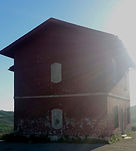
On the way back the sunset was awesome. As I drove west with the setting sun blinding me, I had my first car accident (minor). Part of the road had been washed away and the road maintenance people had put a large metal sign urging caution in the middle of the road. I was driving extremely slowly with my blinkers flashing because I (and presumably other drivers) were blinded by the setting sun. Well I hit the sign and damaged the front bumper. No other damage except to my pocket book.

Wednesday was another beautiful day so I returned to Selinunte to visit the rest of the site. Although it was immense and well described, it was not as atmospheric as the Eastern part of the park. In fact, I hate to say it, but all the temples began to look the same. The Acropolis was highly groomed, with stone pathways, steps, and explanatory plaques; but, no geckos or sheep. On the other hand there were no tourists either. Again the site was covered with Artemesia which in the warm sunshine perfumed the air. I wonder if there is any significance to Artemesia growing in all the temple sites.


The Acropolis was built according to classical plans with three main arteries (two skirting the walls and one up the center) bisected by a grid of smaller streets. There are the remains of 5 temples in this space; but I had difficulty discerning them. Temple A, which is the first Temple to the right of the main central artery, is dedicated to Castor and Pollux and has two spiral staircases (the earliest to date). To the north of this temple, is Temple C, dedicated to Apollo (that is seen in the panorama above). It is the oldest temple (early 6th century BC) and is in the process of being restructured. However, I preferred the smaller details that one encountered as one walked over the “stoops” into the houses, for example, flower pots surrounded by the artemesia and fossils embedded in the stones decorating the house walls. I especially liked walking alone along the ancient main street, imagining that I was there when it was a bustling town.


There is a huge stepped wall surrounding the dunes and a gate (to the north) leading to a still unexcavated necropolis. To the west and outside the Acropolis is the Sancuario della Malophoros-dedicated to Demeter and built in 575 BC. Over 12,000 votive statues were found here as well as the remains of animal sacrifices
I drove home with a glorious sunset and packed for Malta and Etna (with all my winter clothing). I tried to clean up the car (especially the gouges and scratches). I’m hoping that they won’t charge me too much for the damages: front and back bumpers, both side mirrors, and side fenders. After all it is a very small car and made of plastic. The only parts that are not damaged are the doors, the hood, and the roof.
