Well, I had a good surprise on Saturday, the bill was not too bad (120 Euros) It is twice as much as I would have had to pay at the first place but less than I expected, given the luxury. Rita and I exchanged emails and I will keep in touch. She was a wonderful lady, the only daughter in a family with 5 brothers; so, she was ecstatic to have three daughters - All of which are professionals and often travel to North America. I began by visiting the museum at Aidone (where all the finds from the neolithic site of Morgantina are now kept).
Aidone is a hilly town with cobbled streets and small lanes. It, like all Sicilian towns, has a central piazza, from which the streets radiate. I parked in the piazza and walked to the museum which is a beautiful recycled Capucian monastery. It is assessed through the church of San Francesco and there are wonderful views of the former monastery and countryside through many of the windows. As you can see, there are conifers and the feel of a mountain retreat. I don’t know where to start with the exhibits. I was blown away. The general area was dedicated to the cult of Demeter and Kore (also known as Persephone). The lake just outside Enna, Lago di Pergusa, is where myth has it Hades abducted Persophene and carried her to the underworld.


The museum had many of the fine pottery from the late Sicilian Bronze Age to the Roman occupation excavated from Morgantina. It also has some of the finest statues of Demeter and Kore and associated “gods/satyrs”. It also has the Euploemo silverware, which was found hidden under the floor of a house when the Romans sacked Morgantina. I guess the owner didn’t get back. It also has some beautiful terracotta busts that were votive offerings left by young girls hoping for fertility and protection growing up.
However, the “piece de resistance” was the larger than life statue of the Venus of Morgantina (Demeter) and the acroliths of Demeter and Kore. These had been stolen by illegal excavators. In 1988, Enna’s public prosecutor was able to prove that they had been sold to Maurice Tempelsman (last husband of Jackie Onassis) who donated them to the University of Virginia and on loan to the Paul Getty Museum. They were finally returned to Italy in early 2008 - a modern return of Persephone. Although the statue of Demeter (on the right) is impressive in a room of her own with wonderful lighting; what took my breath away was the display of the acroliths of Demeter and Kore. It was otherworldly - something out of a Star Trek episode. There was a gorgeous bust of Persephone, shone to the right of the acroliths.


They too were in a room of their own, looming in the back, with their “archaic smile” and dressed by innovative fashion designer Marella Ferrara. One had an overwhelming impression of being in the presence of the “wise ones”. I was alone in the entire museum and the stillness added to the mood. This has to be my greatest museum experience of my life.
After visiting the museum, I had to go to Morgantina. Dionysius of Halicarnassus, Diodorus Siculus, Thucydides, Justin, Cicero, Livy, Cato, and Pliny have all written about Morgantina. It was famous as having the best wine grapes, the vitis murgentina, in Sicily. It was first settled by Sikels around 3000 BC, became Hellenized in the 6th century BC with many grave goods consisting of imports from Athens and Corinth. Morgantina was “liberated” from the Greeks in 459 BC by Doukertios, a Sikel patriot. It reached its glory around 300 BC. It was sacked by the Romans during the Punic Wars in 213 BC, but eventually rebuilt as a Roman city populated by mercenary Hispanic soldiers. Eunus "liberated" Morgantina in 139 BC during the slave revolt, and died there a prisoner. Morgantina was sacked by Verres in 72 BC and abandoned around 30 BC following its destruction by Octavian.
Again, I was the only person there except for a strange old man in the parking lot. He cornered me and told me that he had been one of the workers on the site and that he had prepared a flyer (in Italian, French, English and German) explaining the site. When I told him that I would prefer to buy a book with more information he stated that there were no books because all the archeologists were dead. He “insisted” that I buy it for 5 Euros- I did! The site is very large with two main areas on either side of the entrance. I wandered along the trails in the site with only the sound of the wind and the smell (very pungent and medicinal) of Artemesia (wormwood) that grew everywhere. I collected some of the plants to place in my drawers and suitcase. I love the smell and will try to bring some back.

I started my wanderings on the western side of the city where there is a remarkably well-preserved public bathhouse (3rd century BC). You can still see the water supply system, underfloor heating pipes, basins, pools, etc. They look as if they were only abandoned yesterday. This is one of the best of the development of a bathing culture before it became standardized by the Romans. Some of the unique features are the rounded thalos or bathing chamber. The water was heated in a special room, stored in tanks and delivered to the thalos which was surrounded by a semi-circle of terracotta tubs. There were niches above the tubs for oils, etc. If you want a tour of the site click here. The website is in Dutch, but it has very many pictures and maps of the site.


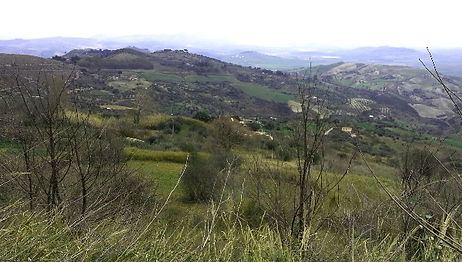
The site had a very strange atmosphere .with many of the excavations abandoned with tools still scattered about as if the workers had left for a lunch break. The views were magnificent and you could imagine that it would have looked very similar 2 thousand/million of years ago.
I spent so much time immersed in the timeless serenity of the hills that I had very little time for the major residential area containing the Agora, the Acropolis, several luxury homes with mosaic floors and frescoed walls, and a Greek theater. The Agora was arranged in two levels with a large stairway connecting the two. I guess Caltagirone was not the first to use this device to solve the problem of a hilly site. The lower part of the Agora was used for sacred rituals while the upper one was used for secular rituals (commerce). Although, there was a sanctuary on the Agora, they have not found any temples.

The Greek Theatre, rebuilt by the Romans, is a semicircular auditorium of 15 steps, divided into 6 areas, accommodating 5000 spectators. It is still used today for performances in the summer. I will try to get back here before I leave Sicily. It is an enchanting site dedicated to rebirth and renewal.
I then left for Pachino and got completely lost. What should have taken me 2 hours took me 6 hours. I should have backtracked to Piazza Armerina and taken the highway, but the map showed smaller roads through several small towns/villages before joining the highway. Plus, I had my GPS lady to guide me. I have rarely been in such a beautiful, but desolate, place. There was no one around except sheep and sheepdogs.

I had to drive slowly because of the conditions of the “roads”. Many ended abruptly at steep cliffs, were washed out, or blocked. It’s a good thing, I was driving a small car since I could back it until there was space to turn around.
Every time I stopped or even slowed down, sheepdogs would try to herd the poor small SMART car. I guess they thought it was a large sheep. I knew that there had to be people around, because I could see crops and an occasional farm house in the distance.

I had visions that I was in another dimension and I would never get back to my dimension. I finally saw a tractor with three farmhands. Fortunately, they spoke Italian and not Sicilian. They told me that most of the roads were impassable to a car and that I had to go to Raddusa. But when I asked how to get to Raddusa, they pointed generally to the left. They said that there were no signs until I got to Raddusa. When I asked again how to get there, they said follow two rules:
1. at every crossroad go up the mountain;
2. always to the left.
If I turned right I would get back into the impassable roads. When I finally got to Raggusa, I stopped for a well-earned cappuccino and two farmers gave me a bag of tangerines and two fennel roots as a goodwill gesture. I then they added the most important rule.
3. stay on asphalt.
I stuck to highways and went north of the autostrada to Catania (way out of my way but fast and certain. The route was awesome with many windmills at the top of the mountains generating electricity. Still very few cars on the road! I finally got home.

Well there were thunderstorms all night and, in the morning, it was pouring so I decided it was a good day to visit the archeological museum in Syracuse. It was cold and the defroster couldn’t remove the condensation on the inside windows; so, I had to drive with the windows open. There were large bodies of water on the road; so every time a car or truck passed me, I would get drenched in water. It is only when I got back to Portopalo that I was told the road often gets flooded in a storm and that I should not have gone. However, I got there, found parking, and recorded the location (so I could find my car) on my GPS. I then walked behind the hospital, through the modernistic Sanctuario della Madonne delle Lacrime to the museum.

When I got to the museum, cold and drenched, I started in the foyer where there was a map of the facility. I The museum contains artifacts from the prehistoric, Greek and Roman periods found in archaeological excavations mostly in and around Siracusa but with some from other related sites. The space is divided into four sectors.
Sector A is dedicated to finds from the upper Paleolithic to the Iron Age.
Sector B is dedicated to the Greek colonies of Sicily (mainly Syracusa) from the Ionic and Doric periods.
Sector C is dedicated to the sub-colonies, mainly Accra, Gela, Agrigento, and Kamarina.
Sector D is dedicated to the Hellenistic and Roman period of Syracusa in the 4th century BC.
Because it was so large, I decided to visit only Sector A. I am very interested in the Neolithic and Bronze Ages and have a cursory knowledge. I find the Greek and Roman history very confusing.
-
Sector A is dedicated from the Upper Paleolithic and the Bronze Age in Sicily. I found this the most interesting exhibition. I had not known that there were dwarf elephants indigenous to Sicily. Two intact adult elephants (male in back and female in front) were found in a grotto in Syracusa. The skeletons of the dwarf elephants are thought to be the basis of the Cyclops myth (one of the clearly Sicilian myths). Cyclopes and Vulcan lived on volcanic Etna. Early humans misinterpreted the hole left by the elephant’s trunk as the third eye. My cane gives you an idea of their size. The exhibitions are mostly of vases from the very simple early vases to the more sophisticated red-burnished vases from Pantalica.


Here is a rough chronology of this time period.
30,000 BC – Homo sapiens probably entered Sicily.
8,000 BC – 7000 BC - Addaura cave drawings (outside Palermo) are evidence of presence of proto-Sicanians. These are thought to be of non-Indo-European origin. Jewelry crafted in Sicily is found at several Neolithic sites and necropoli. Waves of Indo-European migration into Sicily begin and are thought to have introduced agriculture (initially wheat and other grains) in Sicily. Although there are middle Neolithic remains in Stentinello (near Syracuse) there are earlier sites in western Sicily (which I will see next month). Pleistocene Epoch ends and present Holocene Epoch begins.
4000 BC - "Proto-Sicanians" present in Neolithic Sicily and Malta build the world's oldest structures and invent the wheel. Earliest Sicilian religion practiced as evidenced in Morgantina and other Neolithic sites.
2000 BC – 1800 BC - Native non-Indo-European Sicanian culture dominant in Sicily. See for example Casteluccio culture. Use of copper tools ("early Bronze Age"), possibly indicating non-Sicilian influences, prevalent by 2500 BC. Mycenaean and Late Minoan cultures present in isolated eastern localities in 1800 BC.
1300 BC - Probable period of introduction of olive trees in Sicily by peoples of Aegean cultures.
1200 BC - Arrival of Sicels (Sikels), an Italic people, in eastern Sicily. Around this time the Iron Age begins in Greece.
1100 BC - Elymians (possibly from Anatolia in Asia Minor), arrive in western Sicily.
Although I was not able to visit Castelluccio di Noto, an Early Bronze Age Sicani site dated between the fifteenth and nineteenth centuries BC, there is a large display in Section A. The town, on a rocky outcrop, was a fortified acropolis and necropolis. There are more than 200 burial caves dug into the steep walls.
Another, well represented site is Pantalica with its extensive cemeteries of rock-cut chamber tombs (between 4000 and 5000) dating from the 13th to the 7th centuries BC. I will go there over the next few days.

I was truly overwhelmed with the museum, although I could follow section A, I was completely lost in the other sections. I will continue this description another time when I understand the exhibits. In the meantime here are my favourite objects at the museum. They look so vital, as if they could just walk out of the exhibits.


I can't imagine what the pot on the right was used for. They had many of these, all sizes, though most were more than a meter high. maybe they were an early commode, although the pointy objects on the back would be painful.

I left the museum and went to where my GPS lady had said I left the car. It seemed strange because it was a 1 ½ km away. It was pouring rain so I set off anyway. No car. I had mistakenly counted on technology to locate my car and it failed me. I walked around in the rain for an hour trying to find my car. I even asked a policeman to help me, hoping that I had been given a ticket. No such luck. However, he did ask me what I remembered about where I had parked. When I said that I had walked behind the hospital he directed me there and suggested that I walk around in circles looking for the car. I did that for another hour, pressing on the remote at every corner. When a car flashed back at me, I burst into tears. It was my lovely SMART car greeting me. I drove back to Portopalo, soaking wet. Every time the GPS lady told me “observe” the speed limit” I yelled “fuck you lady” and ignored her. When I got back it was already dark and all I wanted was a hot shower. No hot water – so I went to bed, vowing to exchange my GPS lady for a GPS man.
I decided to go to Pantalica and hopefully Castello Euralio so I drove through Ferlà which had the requisite cathedral in the town square and along a narrow winding road with views of the expansive green mountain tops bisected by the stone walls of Syracusa.

I stopped at a booth at the entrance to the site and got a map which showed which roads were passable and also the hiking trails through the site. The road continues to a reserve and then to the top of the gorge where there are parking spaces and signposted walking trails to the bottom and the Anapo River. There are graves (13th to 8th century BC) cut into the side of the gorge with some right along the road. In some places the stone tombs are used as benches to stop and admire the views.


I was the only person at the top of the gorge so I parked the car and walked to the Anaktoron: possibly the remains of the ancient capital of King Hyblon, the Sikel king who gave his name to Megara Hyblaea. Again it was totally magical. There was a strong fresh (5oC) wind and the sound of birdsong. I could hear the Anapo River along the bottom of the gorge and the sound of distant sheep and shepherds. The trails were overgrown with wild fennel that released its aroma when you brushed against it. As it had rained a lot, the frogs were also out. There were masses of lily-like flowers – I don’t know what they were.


The trails were well signposted so I could pace myself as I meandered for hours alone along the stone trails in what appeared to be the top of the world. It really felt as if nothing had changed in thousands of years. I stopped to have lunch sitting on one of the corner stones of the palace of the long-dead Sikel king (800 BC).
I then drove to the other entrance to the Necropolis, Sortino, only meeting disinterested cows. It seems so strange to be the only person here. The only people that existed on this mountaintop had been dead for thousands of years. As I drove back over the mountains back to Portopalo, there were more windmills on the mountaintops generating electricity for the descendants of the Sikels.


The next day I stayed home to recover from my long hike and caught up with correspondence, including reservations for Etna.
Since the day was sunny, I decided on the spur of the moment to drive to Cave Grande di Cassibile. I can now understand why the worship of Demeter and Kore was so strong in Sicily. A miracle happened overnight! Two days ago it was stormy and cold (winter in Sicily); but today, the fields are full of bright yellow flowers - perhaps a type of Oxalis with a wonderful citrus odour, similar to freesias.


The route was through Avola Antica, like the other ancient Sicilian cities, at the top of a mountain. The road was spectacular with a view of modern Avola in the distance and the sea always in sight. The many switchbacks, reminding me of Cape Breton, made it very easy to lose one’s orientation.

The Cave Grande de Cassibile is considered the Grand Canyon of Sicily. It is about 10 km long, carved into the plateau by the Cassibile River. The gorge provides unique flora with some of the plants only found here. To get there, you take a steep road up to the top of a mountain, with a reserve on the right and arrive at a parking lot with a small restaurant, a ticket booth, and a farm house. Since it was almost lunch time, the people at the ticket booth just waved me through. They did say to be careful and not fall off a cliff.

There was no one else there. I spent a few hours walking along the top of the cliff, along the crumbling walls surrounding the abandoned farmhouses and listening to the sound of the river far below. I saw a fox – redder than our foxes and with black markings around the ears and lots of attitude. Again, one felt that one was at the top of the world. Back at the ticket booth there was a group of professional cyclists (all in spandex) at the lookout. They had cycled up the steep road (that I had difficulty in the car) and were on their way down after their training session.


It rained Saturday all day so took the opportunity to stay in, purchasing some on-line books on Sicilian history. I will try to make sense of all I saw; but, it will take some time. Two really good books are Sicily: The trampled paradise by Connie Mandracchia Decaro (which also gives an excellent account of modern Sicily) and On Persephone’s Island: A Sicilian Journal by Mary Taylor Simeti (a Radcliffe graduate who came on a visit and never left). I spent most of the day reading and writing. They are still repairing the roads after the storm, with sand blocking much of the road.
Sunday I packed and went to lunch at Maria who was having a colonoscopy on Monday. She decided to go private so waited a week for the appointment and it cost her 85 Euro. This morning I got my first parking ticket in Portopalo. I misread the sign and thought I could park there for 2 hours. Oh well, my contribution to the town. Tomorrow, I start a new chapter in the South West.
